
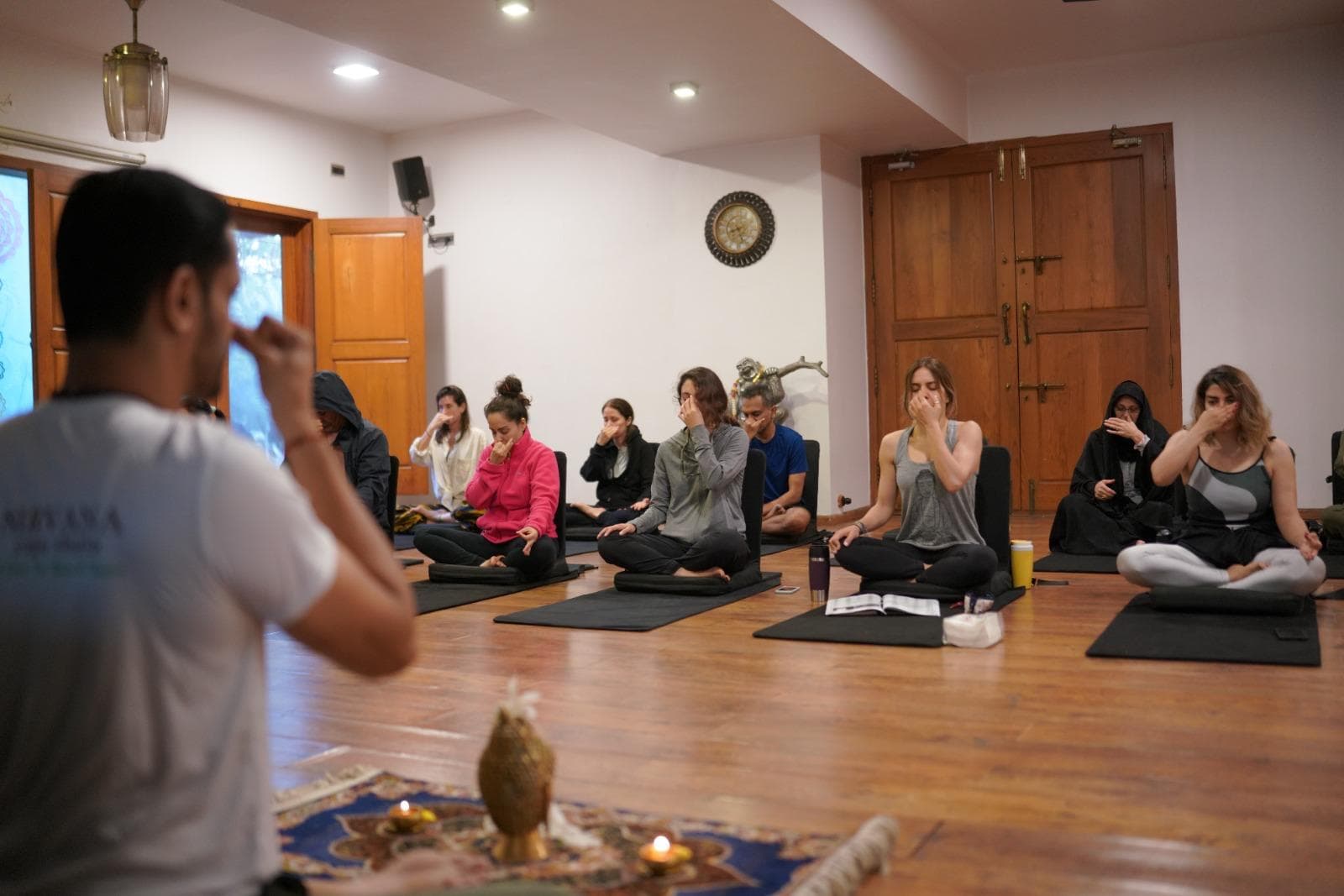
 Early morning pranayama practice
Most of what is written online about pranayama in the "Mysore tradition" is either generic or drawn from other yoga systems entirely. If you have read that Kapalabhati and Bhastrika are part of the Ashtanga pranayama practice, you have read something inaccurate. This matters — particularly if you are coming to Gokulam to train in the traditional system and want to understand what you are actually getting into.
Here is a clear picture of how pranayama actually appears in Ashtanga yoga.
The Breath Is Already There
From your very first Ashtanga class, pranayama is already present — just not in the form most people expect.
Ujjayi breath runs through every asana in the system. It is a slightly constricted nasal breathing that creates a soft, continuous sound at the back of the throat — sometimes described as the sound of the ocean, or a distant wind. In Ashtanga, the breath is not background noise. It is structural. Each vinyasa is counted in breaths; every posture is entered and exited on a specific inhale or exhale. When the breath goes wrong, the entire practice unravels with it.
Learning to sustain ujjayi through a full Primary Series — evenly, without collapse or force — takes most practitioners years of daily work. This alone, done seriously, is a complete pranayama practice in the broad sense. It is also more than enough to occupy a student for a considerable time.
When Formal Pranayama Is Introduced
In the traditional Ashtanga progression, formal seated pranayama practice is introduced after the full Primary Series is established. Not learned — established. Practiced with steadiness, day after day, over time. For most people this means a minimum of one to two years of consistent practice before the question becomes relevant.
The timing is not conservatism for its own sake. The nervous system processes a significant amount through daily asana work — physically, neurologically, and in ways that are harder to name. Adding complex breath techniques before the system has settled tends to produce agitation, disturbed sleep, and a kind of restlessness that interferes with practice rather than deepening it. Teachers who have watched many students rush this step become quite cautious about it.
The introduction to formal pranayama happens at the discretion of your teacher, not according to your own schedule. This is one of the reasons the teacher relationship matters so much in this tradition.
What the Practice Actually Involves
The formal pranayama in the Ashtanga lineage centres on Nadi Shodhana — alternate nostril breathing.
In its foundational form, you alternate closing each nostril with the thumb and ring finger, breathing steadily through the open nostril on each side. In more developed forms, it incorporates:
- Kumbhaka (breath retention) — pausing after the inhale, after the exhale, or both, for a prescribed number of counts
- Specific ratios — a common starting ratio is 1:4:2 (one count inhale, four counts held, two counts exhale), lengthened gradually over months and years
- Bandha engagement — mula bandha and uddiyana bandha held during retention, which refines and steadies the whole practice considerably
This practice is done after asana — after the body has been fully worked and the nervous system has quieted into stillness. It is done seated, unhurried, often in silence. It is not an add-on. It is a continuation of the same arc that begins with the very first surya namaskar.
What Does Not Belong Here
Kapalabhati — rapid forced exhales with passive inhales — is a genuine pranayama technique, but it comes from other yoga lineages, not from the Ashtanga curriculum. You may encounter it in yoga classes in Mysore or Gokulam. You will not find it in a traditional Ashtanga shala labeled as core to the practice.
Bhastrika — forceful rapid inhales and exhales — is similarly from outside the Ashtanga system.
Sama Vritti (equal breathing) is a useful technique but is not specifically an Ashtanga practice — it is used across many traditions.
These distinctions are not pedantic. Part of what gives the Ashtanga system its internal coherence — and its results over time — is that it is genuinely a system, not a collection of techniques from different sources. Mixing in practices from other traditions disrupts the logic of the progression.
If a teacher presents Kapalabhati or Bhastrika as "traditional Ashtanga pranayama," that is a signal worth examining.
The Gokulam Context
Gokulam has a particular pace. The morning practice — arriving before dawn, moving through the sequence as the light comes up, finishing in savasana while the neighbourhood is just waking — has its own pranayama quality in the deepest sense. The breath is present throughout, from the first movement to the last. Working with that seriously, without rushing toward more advanced techniques, is where most practitioners spend their best years.
The general culture among long-term students and teachers here reflects this. The advice you will most consistently hear in Gokulam: go deeper into what you already have before reaching for something new. This is not modesty or gatekeeping — it is what experienced practitioners have observed, repeatedly, about how the practice works.
If pranayama is part of why you are making the trip, raise it directly when meeting potential teachers. Ask: "Do you teach pranayama, and how do you assess when a student is ready?" The answer — and the way it is answered — will tell you something useful about both the teacher and how they understand the full system.
You can browse yoga shalas across Gokulam on Sūtraha before your trip to get a sense of teachers and approaches before you arrive.