

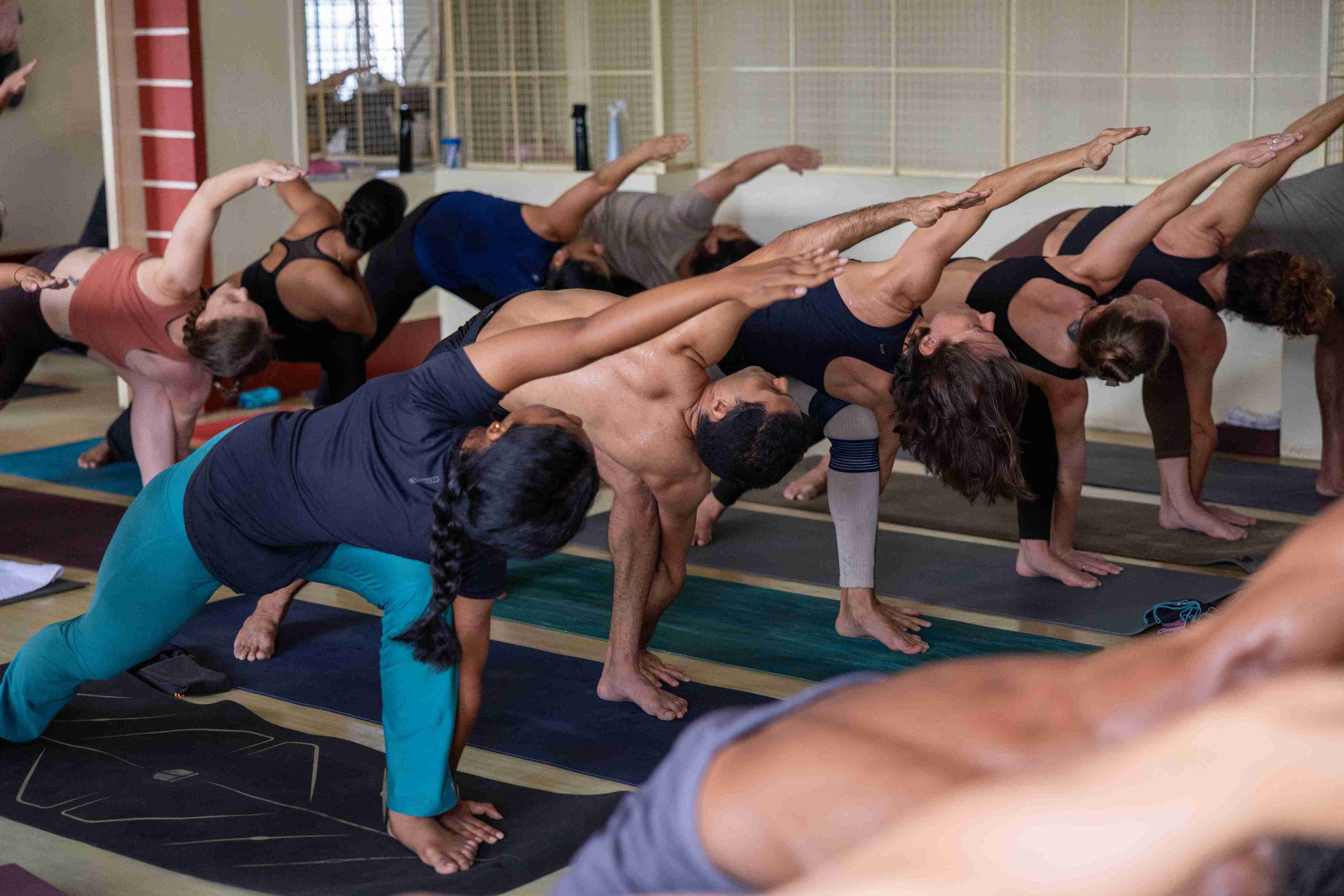
 Mysore style
Mysore style yoga is the traditional method of teaching Ashtanga yoga, where each student practices a memorised sequence of postures independently while a teacher moves around the room giving individual hands-on adjustments and verbal instruction. There is no instructor calling out poses to a group. Everyone works at their own pace and breath count.
The name comes from Mysore, Karnataka, India — the city where Sri K. Pattabhi Jois developed and refined this method over more than six decades. Today, Mysore-style classes are taught in studios worldwide, but Gokulam, a quiet neighbourhood in Mysore, remains the primary destination for serious practitioners.
How Does a Mysore Style Class Work?
A Mysore-style class looks and feels different from most yoga classes. Here is what actually happens:
Students arrive at staggered times. Unlike led classes with a fixed start time, Mysore rooms typically open for a two to three hour window — often from 4:30am or 5:00am. Students enter, unroll their mat, and begin practicing whenever they arrive. There is no group warm-up.
Each student moves through their own sequence. Beginners might practice only the sun salutations and standing sequence — perhaps twenty to thirty minutes of material. Advanced students may practice for ninety minutes or longer, working through Primary, Intermediate, or Advanced Series postures. Everyone is in the same room, doing different things.
The teacher circulates individually. Rather than standing at the front guiding a group, the teacher walks through the room observing each student. They give physical adjustments, verbal cues, and corrections based on what they see in your specific practice. This might mean deepening a twist, correcting your breathing pattern, or adding a new posture when they determine you are ready.
New postures are given one at a time. Students do not learn the full sequence from a chart or video. The teacher adds postures progressively — you practice what you know, and when the teacher decides your current postures are stable, they introduce the next one. This process can take months or years through a full series.
The room is quiet. No music, no talking between students during practice. The only sounds are breathing, the teacher's occasional instructions, and the rhythm of bodies moving through sequences. Many practitioners find this silence one of the most distinctive and valuable aspects of the format.
How is Mysore Style Different from Led Classes?
| Mysore Style | Led Class | |
|---|---|---|
| Pace | Individual — you move at your own breath count | Group — everyone follows the teacher's count |
| Instruction | One-on-one adjustments and cues | General instruction for the whole room |
| Sequence | You practice only what you have been given | Everyone does the same sequence together |
| Start time | Flexible arrival within a window | Fixed start time |
| Level | All levels in the same room | Usually grouped by level |
| Teacher attention | High — individual focus | Lower — attention split across group |
Most traditional Ashtanga schools offer both formats: Mysore-style classes on weekdays and a led Primary Series class on Fridays or Saturdays. The Mysore-style practice is considered the core method; led classes are supplementary.
What to Expect in Your First Mysore Class
Walking into a Mysore room for the first time can feel intimidating. The room is full of people doing different things, nobody is explaining what to do, and the teacher seems busy with other students. Here is what typically happens for a newcomer:
The teacher will come to you. When you arrive and unroll your mat, the teacher will notice you are new. They will come over, ask about your experience, and begin teaching you from the beginning — usually starting with Surya Namaskar A (Sun Salutation A).
You will learn a small amount. On your first day, you might learn only the sun salutations and possibly the standing sequence. This is intentional. The method builds slowly, allowing your body and memory to absorb each piece before adding more.
You will finish before everyone else. Beginners often practice for twenty to thirty minutes while others around them practice for ninety. This is normal and expected. You will gradually practice for longer as more postures are added.
Nobody is watching you. Other students are focused entirely on their own practice. The self-conscious feeling passes quickly once you realise that everyone in the room is absorbed in their own work.
You will need to memorise. The teacher will show you the sequence once or twice. After that, you are expected to remember it and practice on your own. If you forget, the teacher will remind you — but the goal is independent practice. Most people find they memorise faster than they expected.
The Fixed Sequence System
Mysore-style practice follows a fixed sequence of postures organised into series:
Primary Series (Yoga Chikitsa) — meaning "yoga therapy." This is the foundation that most practitioners spend years on. It includes sun salutations, standing postures, seated forward folds, twists, backbends, and a closing sequence. The Primary Series builds the strength, flexibility, and breath control needed for more advanced work.
Intermediate Series (Nadi Shodhana) — meaning "nerve cleansing." This series introduces deeper backbends, arm balances, and leg-behind-head postures. Students typically begin Intermediate only after completing the full Primary Series under a teacher's guidance, which can take several years of daily practice.
Advanced Series (Sthira Bhaga) — meaning "divine stability." These advanced postures are practiced by very few students and require years of sustained, daily commitment.
The progressive nature of the system is one of its defining features. You do not choose which postures to practice — the teacher determines what you are ready for based on consistent observation of your practice over weeks and months.
Why Do Practitioners Travel to Mysore?
Mysore-style classes are available in studios worldwide. So why do thousands of practitioners travel to Gokulam, Mysore every year?
Teaching depth. Teachers in Gokulam have typically practiced for decades and many trained under direct lineage from Pattabhi Jois or his grandson Sharath Jois. The quality of individual attention — the precision of adjustments, the depth of observation — reflects years of experience that newer teachers are still developing.
Daily practice culture. In Gokulam, the practice is not something you fit into your schedule — your entire schedule is built around it. Six days per week, early morning, same room, same teacher. This sustained daily commitment creates shifts in the practice that weekly classes cannot produce.
Community. Practicing alongside dedicated students from around the world, sharing meals, exchanging experiences — this community aspect deepens the practice in ways that are hard to replicate elsewhere.
Tradition. Studying in the city where the method was developed and refined carries a significance that matters to many practitioners. The lineage, the history, the culture of the place itself — all of this informs the practice.
Browse yoga shalas in Mysore on Sutraha to explore where practitioners study, and read our guide to the lineage of Ashtanga yoga for deeper context on the tradition.
Is Mysore Style Right for Me?
Mysore style is suitable for practitioners at every level — from complete beginners to advanced students. In fact, many experienced teachers argue that Mysore style is the best format for beginners, because:
- You receive individual attention rather than trying to keep up with a group
- You learn at your body's natural pace, not the class's pace
- The teacher can address your specific limitations and strengths
- You develop self-practice skills from the very beginning
If you have never tried Ashtanga yoga, you do not need to prepare by taking led classes first. You can walk into a Mysore room with zero experience and the teacher will meet you where you are.
If you are considering studying in Mysore, India, browse places to stay near yoga shalas and wellness services on Sutraha to start planning.
Frequently Asked Questions
What does Mysore style yoga mean?
Mysore style is a method of teaching Ashtanga yoga where students practice a memorised sequence independently while a teacher provides individual adjustments and instruction. It is named after Mysore, India, where the method was developed by Sri K. Pattabhi Jois.
Do I need experience to attend a Mysore class?
No. Mysore style is suitable for complete beginners. The teacher will teach you the sequence from the very first sun salutation and progress you at your own pace. Many teachers consider it the ideal format for beginners because of the individual attention.
How long is a Mysore yoga class?
The room is typically open for two to three hours, but individual practice time varies. Beginners may practice for twenty to thirty minutes. Experienced practitioners typically take ninety minutes to two hours. You arrive and leave based on your own practice length.
What is the difference between Mysore style and Ashtanga?
Ashtanga is the yoga system — the fixed sequence of postures, the breathing method, the philosophy. Mysore style is the traditional way of teaching Ashtanga. You can learn Ashtanga in led classes (group setting), but Mysore style (individual practice with teacher guidance) is the original and primary method.
Why is it called Mysore style?
The method is named after Mysore, Karnataka, India, where Sri K. Pattabhi Jois taught Ashtanga yoga for over sixty years. The specific format of self-paced individual practice with teacher guidance was developed and refined in Mysore, making the city's name synonymous with this approach.