

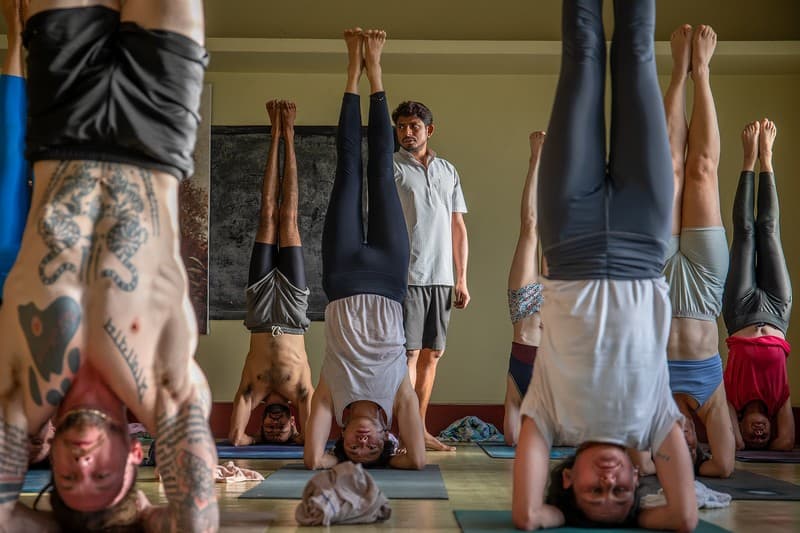
 A quiet Ashtanga shala in Gokulam in the early morning
This question comes up constantly, and the short answer is yes — beginners can absolutely come to Mysore to practice Ashtanga yoga. But the longer, more honest answer involves understanding what you are walking into, what "beginner" actually means in this context, and what you can do before you arrive to make the experience productive rather than overwhelming.
I practice Ashtanga Saadhana with Vijay Kumar in Gokulam, and I have watched many beginners arrive over the years — some well-prepared, some not, all of them navigating something genuinely unfamiliar. Here is what I wish someone had told me clearly before my own first time.
Is Mysore Actually Welcoming to Beginners?
The reputation of Ashtanga yoga as intimidating has some basis in reality, but it is mostly outdated. The image of a stern teacher in a hot room full of advanced practitioners doing impossible postures — while not entirely fictional — is not representative of most shalas in Gokulam today. The culture has shifted. Most teachers here are experienced at working with practitioners at every level, including complete beginners, and they do it daily.
The Mysore-style teaching method is, in fact, specifically designed for individual instruction. Unlike a led class where everyone follows the same pace, in a Mysore room each student works at their own level while the teacher moves around giving one-on-one attention. A beginner doing the first five postures of Primary Series practices alongside someone working through Third Series, and neither is in the other's way. The method accommodates this range by design, not by exception.
That said, welcoming does not mean easy. Gokulam asks real things of you — early mornings, physical intensity, patience with a process that moves slower than your ambition. Beginners are welcome. Casual tourists expecting a drop-in yoga holiday are in the wrong neighbourhood.
What Does "Beginner" Mean in the Ashtanga Context?
This is worth clarifying because people use the word to mean very different things, and the distinction matters for planning your trip.
Complete beginner — no yoga experience at all. You have never practiced Ashtanga or any other form of yoga. This is genuinely fine, but you should be honest about it. Some teachers in Gokulam are better set up for true beginners than others. You will want a teacher who is patient with the memorisation process and who will spend time with you in the first week establishing basics rather than pushing you forward.
Yoga experience but new to Ashtanga. You have practiced vinyasa, Iyengar, Hatha, or another tradition and have a general physical awareness and some familiarity with basic postures. This is a common starting point for Gokulam visitors. The adjustment is less about the body and more about the method — learning to practice independently, memorising a sequence, understanding the count and breath system.
Some Ashtanga experience but never studied in Mysore. You have been practicing Primary Series at home or at a local studio, possibly for years, and want to deepen the work with a teacher in Gokulam. This is arguably the ideal position for a first trip — you already know the basics and can benefit immediately from individual attention and hands-on adjustments.
Each of these starting points leads to a different first week. Be clear with yourself about where you actually are, not where you wish you were.
What Does the First Week Actually Look Like for a Beginner?
The first week is a recalibration, regardless of your level. For a true beginner, it goes something like this.
Day one: You arrive at the shala, probably nervous. The teacher will ask about your experience, any injuries, and how long you are staying. They will teach you Surya Namaskar A — the sun salutation that opens every Ashtanga practice. Depending on the teacher, you may learn Surya Namaskar B as well. You will practice these, possibly only these, and then be guided to the finishing sequence. Your first practice might be 30 to 40 minutes. You will feel like you did nothing. You did exactly enough.
Days two through four: The teacher adds postures one at a time. You might receive two or three new standing postures per day, or one, depending on how you are absorbing them. The emphasis is on breath, on the vinyasa count, on getting the basic shapes into your body's memory so you do not need to think about what comes next. You will feel slow. Everyone around you will seem to know exactly what they are doing. They felt the same way during their first week.
Days five through seven: The initial overwhelm starts to settle. You begin to remember the opening sequence without prompting. The teacher is watching whether you can sustain the breath, whether you are pushing past pain signals, whether you are present. By the end of the first week, you might be working through the first several standing postures on your own before the teacher comes to add the next one. The rhythm of the Mysore room starts to make sense.
The most important thing about the first week is this: it is designed to be slow. The method is not holding you back — it is building a foundation. Teachers who rush beginners through postures to make them feel like they are progressing are doing them a disservice.
How Do Teachers in Gokulam Handle Complete Beginners?
Each teacher has their own approach, but the general pattern across Gokulam is remarkably consistent.
Good teachers start with an assessment. They want to know what your body can do, where your limitations are, and whether you have injuries or conditions they need to work around. They will ask directly, and you should answer honestly. Do not minimise an injury or exaggerate your experience — the teacher is calibrating their approach to you, and inaccurate information leads to adjustments that do not serve you.
Most teachers give beginners a specific time slot, often slightly later in the morning than the experienced practitioners. This is practical — it allows the teacher to give you more focused attention when the room is less full, and it means you are not navigating a crowded shala while trying to remember your second posture.
Hands-on adjustments will begin from day one, gently. A good teacher's hands tell you things words cannot — where to engage, where to release, how far into a posture your body can currently go safely. If an adjustment feels wrong or painful, say so immediately. No experienced teacher in Gokulam wants to injure you, but they can only work with the feedback you give them.
Over the first month, the teacher builds your practice posture by posture. There is no standard rate of progress — some beginners move through the standing sequence in two weeks; others take a month. Both are completely normal. The teacher is watching your body, your breath, your consistency, and your attitude. All of these factor into when you receive the next posture.
You can explore different teaching approaches by browsing shalas on Sutraha before you arrive.
What Should You Practice Before Coming to Mysore?
You do not need to arrive with an established practice. But arriving with some preparation makes the first week significantly smoother and allows you to benefit from the teaching more quickly.
Learn the basic Surya Namaskar A sequence. There are reliable videos and resources available. If you can move through five rounds of Sun Salutation A with the correct breath count before you arrive, you have a genuine head start. The breath-movement coordination is the most important thing to practice — inhale arms up, exhale fold forward, inhale look up, exhale step back, and so on. Get this into your body at home.
Build some baseline fitness. Ashtanga is physically demanding. You do not need to be an athlete, but if you are completely sedentary, the first two weeks will be harder than necessary. Regular walking, some basic strength work, and general flexibility maintenance will help. Do not try to prepare by doing intensive yoga — just arrive with a body that is accustomed to moving.
Practice waking up early. This sounds trivial. It is not. If your normal wake-up time is 8am and you suddenly need to be on a mat at 5:30am, the first week will be about exhaustion rather than about learning. Start shifting your schedule two to three weeks before departure. Even getting up at 6am regularly before you arrive makes a noticeable difference.
Read about the method. Understanding what Mysore-style practice is, how it differs from a led class, and what the sequence structure looks like will reduce your first-day confusion considerably. You do not need to memorise the full Primary Series — just understand the format.
What About the Intimidation Factor?
I will not pretend it does not exist. Walking into a Mysore room for the first time, especially one with experienced practitioners, can feel exposing. Everyone seems to know exactly what they are doing. The room is quiet except for breath. No one is explaining what to do. You are standing on your mat wondering if you are in the right place.
Here is what helps: understand that every single person in that room had a first day. The practitioner flowing through a graceful backbend behind you once stood on their mat not knowing what Surya Namaskar was. The teacher has seen thousands of beginners walk in with exactly the expression you are wearing right now. None of this is new to them. You are not a disruption — you are a normal part of the room.
The Mysore room is also, by nature, an inward-facing practice. People are not watching you. They are absorbed in their own work. The quiet that might feel intimidating at first is actually protective — no one is performing, no one is competing, and the focus of the room is directed inward. Within a few days, you will start to appreciate this rather than feel exposed by it.
What If You Feel Completely Lost?
It happens. It is normal. The teacher is there specifically for this situation. If you lose your place in the sequence, stand on your mat and wait — the teacher will come to you. If you forget a posture, the teacher will remind you. If you need to rest, rest. There is no failure condition in a Mysore room other than not showing up.
Some teachers also offer introductory courses or beginner workshops at the start of each month. These provide a structured introduction to the method before you join the main Mysore room. If this option is available at your chosen shala, it can ease the transition considerably.
How Long Should a Beginner Stay in Mysore?
A minimum of one month. This is not arbitrary — it reflects how the learning process actually works.
The first two weeks are acclimatisation. You are adjusting to the climate, the food, the early mornings, the time zone, and a completely new physical practice. Very little feels settled during this period. If you leave at two or three weeks, you leave at the hardest point without having reached the phase where things start to click.
Weeks three and four are where the practice begins to feel like yours. You know the sequence up to wherever you have been taught. Your body starts anticipating the movements rather than following instructions. The teacher begins to refine rather than introduce. The morning rhythm — wake, practice, eat, rest, repeat — becomes a structure that supports you rather than one you are fighting.
Six weeks is better. Two months is better still. But one month is the minimum for a first visit if you want to leave with something that will sustain your practice at home.
What Are Realistic Expectations for a Beginner's First Trip?
You will not learn the full Primary Series in a month. Most beginners, practicing six days a week with a good teacher, will get partway through the standing sequence and into the first few seated postures. Some will get further; some will stay with a shorter practice that the teacher wants to deepen before adding more. Both outcomes are productive.
What you will learn, and what matters more than the number of postures, is the method itself — how to practice independently, how to breathe correctly, how to approach the practice with consistency rather than ambition. These are transferable. When you return home, you will be able to maintain a daily practice that continues to develop even without a teacher in the room.
You will also learn things about yourself that have nothing to do with yoga postures. The practice is structured to reveal patterns — how you respond to difficulty, where you hold tension, what your relationship to patience actually looks like when tested daily. This is not mystical language. It is the straightforward experience of doing something challenging every morning for a month.
What Practical Things Should a Beginner Know Before Arriving?
Bring your own mat. You can buy mats in Mysore, but arriving with a mat you are familiar with removes one variable from an already variable-heavy experience.
Moon days are rest days. Most traditional shalas do not practice on full and new moon days. Saturday is the weekly rest day. Respect the rest days — they are part of the method, not optional time off.
Saturday is a rest day. The traditional Ashtanga week is Sunday through Friday, with Saturday off. Some shalas also take Sundays off. Confirm the schedule with your chosen shala.
Eat simply. Your body is processing a lot through daily practice. Heavy meals, unfamiliar spices in large quantities, and late dinners will make mornings harder. Gokulam has excellent food options that the yoga community has shaped over the years — simple, nourishing, and digestible. Check Sutraha's local businesses for current options.
Be patient with yourself. This is the most important practical advice I can offer. The practice is a slow process that rewards consistency over intensity. Your first trip is the beginning of something, not the whole thing.
If you are a beginner considering the trip, start by exploring what is available in Gokulam on Sutraha — shalas, accommodation, and services — to build a realistic picture of what your first visit will look like. The questions you have now are the right questions to be asking. The answers become clear once you are on the mat.