

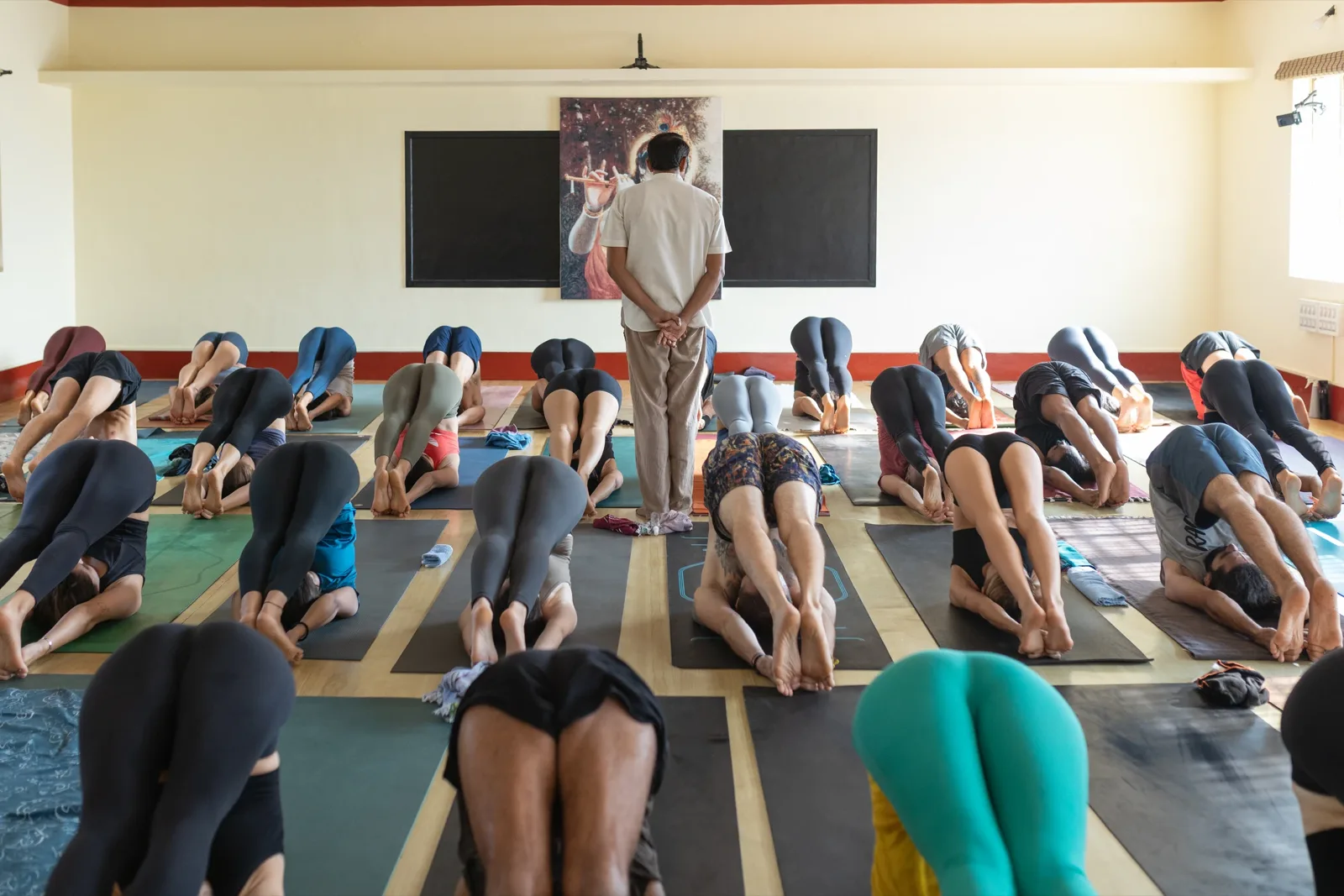
 A quiet Ashtanga shala in Gokulam in the early morning
The tricky thing about choosing a teacher in Gokulam isn't that there are too few options — it's that there are many sincere ones, each with a distinct style and atmosphere. The teacher-student relationship will define your time here more than your accommodation, your visa timing, or anything else you can plan for in advance.
Here is what actually helps when you are trying to decide.
The Authorization Question — and Why It Is Not the Whole Story
For a long time, the standard advice was straightforward: find a teacher with authorization from the KPJAYI (Krishnamacharya Pattabhi Jois Ashtanga Yoga Institute). That credential still means something — it indicates someone trained under close supervision, was formally assessed, and carries a direct lineage connection. As a starting point, it narrows things down sensibly.
But Gokulam's teaching community has grown well beyond any single institution. There are teachers here who spent years training intensively with respected senior practitioners and hold no formal papers. And there are authorized teachers whose classes can feel mechanical or impersonal. The credential is a filter, not a verdict.
What you are really looking for — and what no piece of paper tells you — is whether a teacher can actually see you: your particular body, your particular blocks, your particular stage of the practice. That only becomes clear in person.
What the First Week Tells You
Most shalas in Gokulam offer a trial period before you commit to a monthly fee. Use it fully. During that first week, pay attention to more than whether the teacher adjusts you — watch how they adjust:
- Are adjustments responsive to how your body is that morning, or applied by habit regardless of what is actually happening?
- Does the teacher notice when you struggle, or only when you accomplish something new?
- Is the room quiet enough to track your breath, or is there a chaotic energy that never settles?
- By day three, does the teacher know your name?
A Mysore-style class should feel like a room full of people practicing alone together. That quality of focused quiet is partly the students' responsibility — but mostly, the teacher sets it. If the energy on day one feels performative or rushed, that rarely improves.
The Morning Rhythm
In Gokulam, the yoga day starts before the sun. Shalas open between 4:30 and 6am. The streets are still dark when the first students arrive — you walk quietly, mat under your arm, passing the neighbourhood dogs settled in doorways. By 8 or 9am, practice is done and the neighbourhood exhales. The coconut stalls fill up with post-practice students cooling down, the tea spots do steady business, and the familiar debate about where someone is in the sequence carries on at outdoor tables.
This rhythm shapes everything, including how you choose a teacher. A teacher whose schedule matches your natural energy is not a trivial consideration when you are doing this six mornings a week for months. Early-morning types thrive on a 5am start without a second thought. If you have never been a morning person, adjusting to this is part of what Gokulam asks of you — and that is fine. But know it going in.
Honest Questions to Ask
When you visit a shala for the first time, ask:
"How long have you been teaching the Mysore method?" — Not just practicing, but teaching. The difference matters considerably.
"What is your approach to injuries?" — A thoughtful teacher will ask about yours before you even step on the mat. Notice whether they ask at all.
"How do you handle students at different stages in the same room?" — The Mysore method is designed for this, but not every teacher manages the full range of levels with equal attention.
"Do you observe moon days?" — Most traditional shalas in Gokulam rest on full and new moon days. If a shala practices straight through without acknowledgment, that tells you something about how closely they follow the traditional method.
Good teachers ask questions back. They want to understand your practice history, your injuries, how long you are staying, what you are hoping to work on. If a teacher seems genuinely uninterested in any of this before you start, take note.
What Makes Gokulam Different
Gokulam's teaching culture is shaped by the kind of students who show up here. Because most people have made a serious commitment to be in this neighbourhood — months of planning, real cost, often major rearrangements of work and life — the overall level of sincerity in local shalas tends to be unusually high. Teachers have calibrated their approach to students who mean it.
That said, the neighbourhood has grown considerably. Some shalas have expanded into larger spaces with many students; others have stayed deliberately small and personal. Neither is inherently better. What matters is whether the environment matches the kind of focus you are bringing with you.
Give Yourself Time
A common mistake first-time visitors make is committing to a shala within the first two or three days — often because they are anxious about finding a place, or because the first shala they tried was convenient. There is no rush. Spend a week arriving, let the jet lag clear, walk around, try a couple of trial classes. The right fit for a month-long stay is worth a few days of looking.
The teacher you end up with will, in all likelihood, be the teacher you return to. That relationship has a longer arc than you might expect on arrival.
Before your trip, you can browse yoga shalas across Gokulam on Sūtraha to compare teachers, locations, and approaches — a useful starting point before you land.