

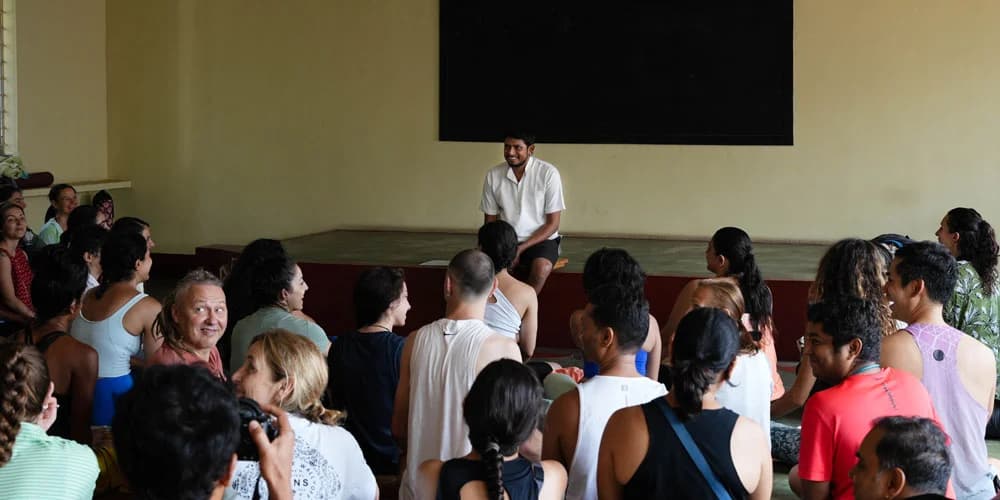
 Vijay Kumar's Philosophy class on Yogsutra
Most practitioners arrive in Gokulam for the asana practice. They come for the Mysore room, for hands-on adjustments from an experienced teacher, for the discipline of six mornings a week on the mat. That is the core of what Gokulam offers, and for many people it is more than enough to fill a stay of any length.
But Gokulam also holds something else — a concentration of study opportunities that exist precisely because so many serious practitioners are here. Sanskrit teachers, chanting classes, philosophy study groups, and kirtan gatherings have grown in this neighbourhood alongside the shalas, shaped by the same community that sustains the physical practice. These are not add-ons or tourist activities. They are the broader context that the asana practice exists within, and for many practitioners, engaging with them changes how the physical practice feels and what it means.
I practice Ashtanga Saadhana with Vijay Kumar in Gokulam, and over time the studies I have pursued alongside the asana practice have become inseparable from it. Here is what is available, and why it matters.
What Sanskrit Classes Are Available in Gokulam?
Sanskrit study in Gokulam ranges from absolute beginner courses to advanced grammar and textual study, and the quality of instruction is surprisingly high for a small residential neighbourhood. Several dedicated Sanskrit teachers have established themselves here specifically because of the yoga community's interest.
Alphabet and pronunciation courses are the most common entry point. These typically run for a few weeks and cover the Devanagari script, the systematic phonetics of Sanskrit (which is a remarkably logical language in this regard), and correct pronunciation of the sounds that appear in mantras, chanting, and yoga terminology. Even a basic course fundamentally changes how you hear and speak the words you have been using in practice — asana names, the opening and closing mantras, the terms your teacher uses during instruction.
Grammar courses go deeper into the structure of the language. Sanskrit grammar is extraordinarily systematic — the ancient grammarian Panini codified the entire language in roughly 4,000 rules, and the logical precision of the system is part of what draws analytically minded practitioners to study it. A grammar course in Gokulam might cover basic sentence construction, verb conjugation, and noun declension over a period of weeks or months. This level of study is not necessary for most practitioners, but for those drawn to it, the experience of reading a yoga sutra in its original language rather than in translation is genuinely different.
Reading and chanting courses focus specifically on the texts that are most relevant to yoga practitioners — the Yoga Sutras of Patanjali, selections from the Bhagavad Gita, and Vedic hymns. These courses teach you not just to read the texts but to chant them with correct metre, accent, and rhythm. The oral tradition of these texts is as important as their written form, and learning to chant them is learning to engage with them in the way they were originally transmitted.
You can find current Sanskrit offerings through Sutraha's services listings, which cover what is running in Gokulam at any given time.
How Does Vedic Chanting Work, and Why Do Practitioners Study It?
Vedic chanting is one of the oldest continuous oral traditions in human history — an unbroken chain of precise sound transmission stretching back thousands of years. In Gokulam, Vedic chanting classes offer practitioners direct access to this tradition, and the experience of participating in it is unlike anything most Western practitioners have encountered before.
The chanting is not singing in the way most people understand music. Vedic chants follow specific tonal patterns — traditionally marked by three pitch levels: udatta (raised), anudatta (lowered), and svarita (a combination). The precision of these tones matters. The tradition holds that the sounds themselves, when produced correctly, have a direct effect — on the practitioner, on the nervous system, on the quality of attention. Whether you engage with this on a spiritual, physiological, or purely aesthetic level, the experience of chanting in a group with correct pronunciation and rhythm is genuinely powerful.
What a typical chanting class looks like: A teacher chants a line, and the students repeat it. Then the next line. Gradually, the lines connect into longer passages. The process is deliberate, repetitive, and requires sustained focus — qualities that practitioners of Ashtanga yoga will recognise immediately. Many students describe the concentration required for chanting as directly analogous to the concentration of the asana practice, which is not a coincidence. Both are training the same faculty of attention through different means.
Common chanting texts in Gokulam include:
- The opening and closing mantras of the Ashtanga practice
- Selections from the Taittiriya Upanishad
- The Yoga Sutras of Patanjali (chanted in their original Sanskrit)
- Vedic peace chants (Shanti Mantras)
- The Bhagavad Gita, typically selected chapters
For practitioners who are in Gokulam for a month or longer, even a short chanting course of two to three weeks can fundamentally shift how you relate to the mantras you recite at the beginning and end of each practice. The words stop being sounds you approximate and become something you understand and produce with intention.
What Yoga Philosophy Study Is Available in Gokulam?
Philosophy study in Gokulam takes several forms, from structured courses to informal discussion groups, and the depth available reflects the seriousness of the community.
Yoga Sutra study groups are perhaps the most common offering. Patanjali's Yoga Sutras — 196 concise aphorisms on the nature and practice of yoga — are the foundational philosophical text for most practitioners in the Ashtanga tradition. Study groups work through the text systematically, often sutra by sutra, exploring the Sanskrit terminology, the traditional commentaries, and the practical implications for daily practice and life.
The experience of studying the Yoga Sutras while maintaining a daily Ashtanga practice creates a feedback loop that reading the text at home does not. When the sutras describe the nature of the mind, the role of practice and detachment, or the stages of concentration, you have a morning practice that provides direct experiential reference points. Theory meets practice in a way that is immediate rather than abstract.
Bhagavad Gita study is also available, sometimes as a formal course and sometimes as a reading group. The Gita's exploration of duty, action, and the nature of the self resonates strongly with practitioners who are engaged in the daily discipline of a demanding physical practice. The questions it raises — about why we do what we do, about the relationship between effort and surrender, about acting without attachment to results — are questions that the practice itself raises, often uncomfortably.
Broader Indian philosophy courses covering Samkhya, Vedanta, and other darshanas (schools of thought) appear periodically, usually offered by visiting scholars or by teachers who have studied these traditions in depth. These provide the wider intellectual context within which yoga philosophy sits — helpful for understanding why certain concepts in the Yoga Sutras are presented as they are and how they relate to the larger tradition of Indian thought.
Are Philosophy Classes Accessible to Beginners?
Most philosophy offerings in Gokulam assume no prior background. Teachers here are accustomed to working with practitioners whose primary engagement is physical practice and who are approaching philosophical study for the first time. Good teachers connect the concepts directly to practice experience, avoiding the trap of making philosophy feel like an academic exercise disconnected from what you do on the mat each morning.
That said, some courses move faster or assume more familiarity than others. If you are genuinely new to yoga philosophy, start with a Yoga Sutra introduction course rather than jumping into an advanced Vedanta seminar. Build the foundation first — a pattern that, as an Ashtanga practitioner, you are already familiar with.
Check Sutraha's events listings for current philosophy courses and study groups in Gokulam.
What Is Kirtan, and Where Does It Happen in Gokulam?
Kirtan — the practice of call-and-response devotional chanting — occupies a different space from formal Vedic chanting or Sanskrit study. It is less structured, more communal, and more emotionally expressive. In Gokulam, kirtan gatherings happen regularly, often in the evenings, and they attract practitioners across traditions and experience levels.
A typical kirtan session involves a lead singer or group who chant a mantra or devotional phrase, with the assembled group responding. The chants build in rhythm and intensity, often accompanied by harmonium, tabla, and other instruments. There is no requirement to know the words in advance — the repetitive, call-and-response format means you learn by participating.
For some practitioners, kirtan is a deeply spiritual experience. For others, it is a social gathering with beautiful music. For many, it falls somewhere in between — a space where the rigid discipline of the morning practice gives way to something more open and less controlled. After weeks of silent, focused Mysore-room mornings, the communal expression of kirtan provides a genuine counterbalance.
Kirtan in Gokulam is not limited to any single tradition or lineage. You will find gatherings that draw on Vaishnava bhakti traditions, on Shaiva mantras, and on more eclectic repertoires. The community is broad enough to support this range, and most gatherings welcome everyone regardless of background or belief.
How Do These Studies Complement the Asana Practice?
This is the question that matters most, and the answer is more practical than it might initially sound.
The Ashtanga system as Patanjali describes it has eight limbs — asana is the third. Pranayama is the fourth. The first two limbs, yama and niyasa, are ethical and personal observances. The final four — pratyahara, dharana, dhyana, and samadhi — relate to progressively deeper states of concentration and absorption. Philosophy study, chanting, and Sanskrit learning are not separate from the asana practice — they are engagements with the other limbs of the same system.
Practically, what changes:
Chanting improves breath awareness. The precision required to chant correctly — sustaining tone, managing breath across long phrases, maintaining awareness of rhythm — trains exactly the same respiratory awareness that the asana practice demands. Many practitioners report that their ujjayi breathing improves after a period of regular chanting practice.
Sanskrit study changes how you hear instruction. When you understand the etymology of asana names, when you know that "utthita" means extended and "parivritta" means revolved, the sequence stops being a memorised list and becomes a descriptive language. You start to understand the logic of the practice from the inside.
Philosophy study provides context for difficult periods. Every practitioner hits phases where the practice feels stagnant, frustrating, or pointless. The Yoga Sutras address this directly — Patanjali writes explicitly about obstacles, about the fluctuations of the mind, about the long timeline of genuine transformation. Having studied these texts does not make the difficult phases disappear, but it reframes them. You are not failing. You are experiencing what the tradition predicts you will experience.
Community deepens through shared study. The conversations that happen after a philosophy class or a chanting session are different from the conversations that happen after asana practice. They go to different places, address different questions, and connect people across practice levels in ways that the shala room does not always facilitate.
How Much Time Do These Studies Require?
Most Sanskrit, chanting, and philosophy offerings in Gokulam are designed around the schedule of practitioners who are already doing intensive daily asana practice. Classes typically run in the late morning or afternoon — after practice, after breakfast, after the initial rest period.
A realistic commitment might look like:
- Sanskrit: Two to three classes per week, 60 to 90 minutes each
- Chanting: Three to five sessions per week, 45 to 60 minutes each
- Philosophy: One to two sessions per week, 60 to 90 minutes each
You do not need to do all of these simultaneously. In fact, adding too many study commitments alongside a daily Ashtanga practice can create the kind of overscheduled life you probably came to Gokulam to step away from. Choose one area that genuinely interests you and engage with it seriously. You can explore other areas on subsequent trips.
The afternoon hours in Gokulam are genuinely spacious. After morning practice, breakfast, and a rest period, there is substantial time before the early evening and the early bedtime that the practice schedule demands. Filling some of that time with study gives the day a shape that supports the overall rhythm of the Gokulam life.
How Do You Find Current Offerings?
The landscape of study opportunities in Gokulam shifts with the seasons. Teachers come and go, courses start and end, new offerings appear as the community evolves. What was running six months ago may not be running now, and something new may have started since.
Start with Sutraha's services page for current listings of Sanskrit, chanting, philosophy, and other study offerings across Gokulam. The events page covers workshops, intensives, and shorter courses that may run for specific periods.
Ask at your shala. Many teachers maintain awareness of what complementary study opportunities are available in the neighbourhood and can point you toward specific teachers or courses that align with your interests and level.
Talk to other practitioners. The community in Gokulam is well-connected, and word of mouth remains one of the most reliable ways to find quality instruction. Someone in the coconut line after practice will know who is teaching what.
The asana practice is the entry point for most practitioners, and it remains the foundation for good reason. But Gokulam's particular gift is that it offers the wider context — the language, the sound, the philosophy — in a setting where these studies feel natural rather than forced. They are here because the practice community created a demand for them, and they continue because practitioners consistently find that engaging with them changes something about how the physical practice lands.
You do not need to pursue any of this on your first trip. But knowing that it is here, whenever you are ready for it, is part of what makes Gokulam what it is.